
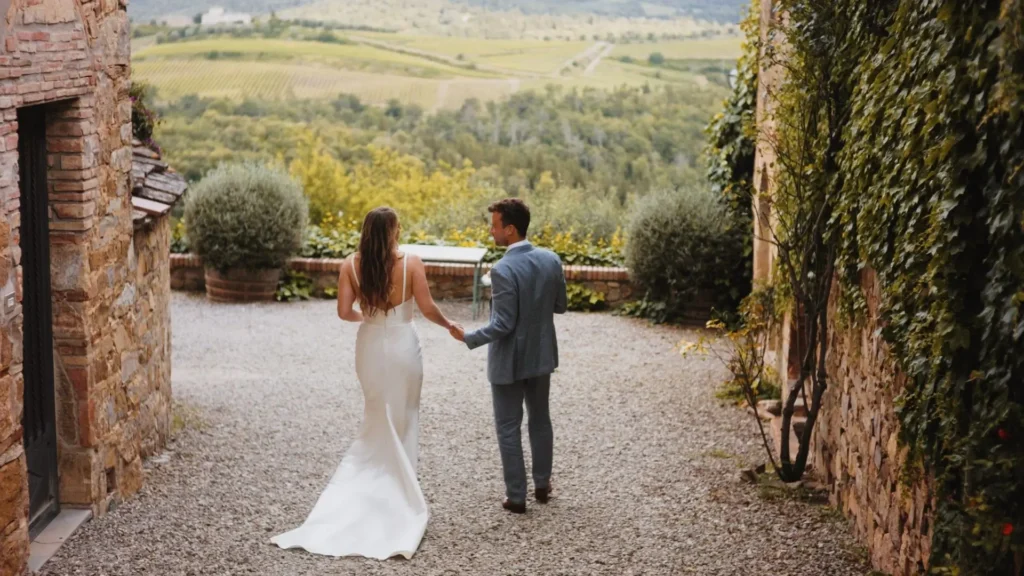
My work doesn’t start on the wedding day. It starts much earlier, the moment a couple writes to me for the first time and describes, in still-vague words, the idea of getting married in Italy.
Already in that first conversation, while I listen, I’m already thinking about the light. The way it falls across certain Tuscan vineyards in late summer. How it reflects off the surface of Lake Como in the early afternoon. The dramatic verticality of an Amalfi cliff in backlight.
Every choice a couple makes — the region, the season, the venue, the ceremony time — doesn’t just define the celebration: it defines the film. This guide was written from that perspective: not a generic checklist, but a planning journey seen through the lens of the person who will, in the end, have to tell that story.
Why Italy? What Makes a Destination Wedding Here Different
Italy has been one of the most beloved wedding destinations in the world for decades — and the reasons go far beyond the weather or picture-postcard scenery. It’s the variety that makes the difference.
Rolling hills and Renaissance villas in Tuscany, aristocratic elegance on the shores of Lake Como, dramatic cliffs along the Amalfi Coast. Add to that centuries of art and architecture, a food and wine culture that turns every dinner into an unforgettable moment, and a warmth of hospitality that makes even guests arriving from the other side of the world feel at home.
For international couples, this transforms the wedding into something larger than a single day: an event worth crossing an ocean for. Guests fly in, stay for an entire weekend, and that completely changes the rhythm — and the story — of the celebration. It’s no longer just an afternoon. It’s an experience.
If you’d like to understand in more detail why Tuscany in particular has become such a reference point for international couples, I’ve written a dedicated piece on why choose Tuscany for your destination wedding.
Step 1: Choose Your Region (and the style that goes with it)
The region is the first decision and the one that shapes everything else. Not just the logistics, not just the style of the celebration: from my perspective, it also determines the entire cinematic language of the film. Three areas dominate the destination wedding scene in Italy, and each carries a distinctly different visual character.
Tuscany: Gentle Hills and Late-Afternoon Light
Tuscany remains the most sought-after region, and it’s not hard to understand why. The variety is extraordinary: stone farmhouses, cypress-lined avenues, Renaissance villas and vineyard estates, often all within the same property. The Val d’Orcia area in particular is known for its warm, golden late-afternoon light — a quality that cannot be replicated in a studio, and that has become the visual signature of countless Tuscan wedding films.
I’ve put together everything you need to know about planning a destination wedding in Tuscany in a dedicated guide.
Lake Como: Aristocratic Elegance and Stories on the Water
Lake Como is the choice for couples seeking a sophisticated, timeless luxury. Historic villas overlooking the water, arrivals by boat, mountains reflected on an almost perfectly still surface: it’s a visually more formal and powerful backdrop than the Tuscan countryside.
It also comes with its own logistical considerations — including, in some areas, noise restrictions worth checking early if you’re planning a party that runs late into the night. I cover this in detail in my guide to luxury wedding films on Lake Como.
The Amalfi Coast: Dramatic Cliffs and Vertical Storytelling
The Amalfi Coast offers unmatched visual spectacle: terraces perched above the sea, villages like Positano and Ravello climbing almost vertically from the water. It is also the most logistically complex region: narrow roads, restricted access, unpredictable traffic. But handled with the right experience, these same challenges become part of the story — as I explain in my guide to filming luxury weddings on the Amalfi Coast.
| Region | Atmosphere | Best Months | Logistics Level |
| Tuscany | Rustic-elegant, golden light | May–June, September–October | Medium, good road access |
| Lake Como | Formal, aristocratic | May–September | High: boat transfers, noise rules |
| Amalfi Coast | Dramatic, coastal | May–June, September–October | High: narrow roads, traffic |
Beyond these three, Puglia, Umbria, Venice and Sicily are also gaining popularity among international couples looking for something different.
Step 2: Pick the Right Season and Date
The high season in Italy runs from May through October. July and August bring the most intense heat — and the busiest venues. The middle months — May, June, September and October — offer the best balance of pleasant weather, softer light and more room to negotiate with vendors. Winter weddings, though less common, are increasingly chosen by couples who want a more intimate celebration, outside the seasonal rush and with less pressure on vendor availability.
I’ve written something specific on each of these seasons: on winter weddings in Tuscany, on spring weddings in Tuscany, and on what it means to get married in Tuscany in summer.
From my perspective, the season is never just a question of temperature: it shapes the angle of the light, the time golden hour arrives, even the colour of the landscape. An evening ceremony in Tuscany in June and one in September, in the same location, can produce a completely different cinematic aesthetic — simply because of how the light moves in those months.
Step 3: Find Your Venue
Once region and season are decided, the venue search begins. Italy offers an enormous range — historic villas, medieval castles, hilltop villages, vineyard estates, lakeside properties, seaside terraces — and each one has its own visual personality that will shape every single frame of your film.
When evaluating a venue, don’t stop at the photographs. Ask about capacity, exclusive use, indoor ceremony options in case of rain, noise and music curfews, on-site accommodation for you and your guests, and whether drone filming is permitted on the property. These are details that directly affect your guests’ experience — and from my point of view, they also determine what we’ll be able to capture, and under what conditions.
A venue with large, light-filled indoor spaces and no strict time limits tells a different story from one with a panoramic terrace but complicated access. Neither is the wrong choice — but it matters to know the difference before falling in love with a photograph.
For couples exploring options in Tuscany, I’ve put together a selection of the most exclusive wedding villas in Tuscany seen through my lens, with dedicated features on properties like Borgo Divino, Villa Gamberaia and Villa Medicea di Lilliano, all of which I’ve had the pleasure of filming.
Step 4: Legal Requirements and Ceremony Type
One of the first things to clarify when planning a wedding in Italy is the type of ceremony: legally marrying in Italy, or completing the paperwork at home and celebrating here with a symbolic ceremony?
Both paths are common. A civil or religious ceremony held in Italy carries full legal weight. A symbolic ceremony allows you to celebrate however you like, with the legal marriage finalised separately in your home country — before or after the trip. The requirements for a legally binding marriage in Italy vary by nationality and generally involve specific documentation, translations, and a process through the relevant consulate and local municipality. Since the rules change over time and differ from country to country, this section should be read as general guidance, not legal advice. Before making any commitments, always check the current requirements directly with official sources — the Italian Ministry of Foreign Affairs and the consulate for your nationality are the right places to start.
Step 5: Build Your Timeline and Budget
For a destination wedding in 2027 or 2028, most experienced wedding planners and vendors recommend starting to plan 18 to 24 months in advance — especially if you already have a popular venue in mind during peak season. Summer dates at the most exclusive villas in Tuscany, Lake Como and the Amalfi Coast are booked within this window, sometimes even earlier.
| Months Before the Wedding | Priority |
| 18–24 | Choose region, venue and wedding planner |
| 15–12 | Book key creative vendors: photographer, videographer |
| 9–6 | Define the multi-day programme (welcome dinner, farewell brunch) |
| 6–4 | Confirm décor, flowers and lighting plan |
| 3–1 | Final details, vows, guest logistics |
On the budget side, the main items to account for are the venue, catering, travel and accommodation logistics for you and your guests, and any vendor travel fees. A destination wedding in Italy often involves higher logistical costs than a local one — simply because more people and more equipment need to travel.
For a detailed breakdown of what to expect on the videography side specifically, I’ve written a dedicated guide to wedding videographer costs in Italy.
Step 6: Vendor selection (planner, photographer, videographer and more)
A destination wedding in Italy typically involves a wedding planner, a venue coordinator, a photographer, a videographer, a florist, a caterer, hair and make-up, musicians and a transport service.
For each one, look carefully at the portfolio, the consistency of their style with yours, their specific experience with destination weddings — which have very different logistics from local ones — previous couple references, and exactly what is included in the contract.
Choosing Your Videographer
Here, naturally, I have something to say from personal experience. The questions I always recommend asking before booking cover what is included in the final deliverables, how discretion is handled during the ceremony, what backup equipment is brought, and how the team coordinates with the photography team on the day.
I’ve gathered the 10 essential questions to ask before hiring a wedding videographer in a dedicated article, where I also explain what to expect in your final wedding video deliverables and what to expect from your videographer on the day. If you’re still wondering whether video is worth the investment at all, the article on why make a wedding video is the right place to start.
Step 7: Design the wedding weekend and the guest experience
Since almost all guests are travelling from abroad, a destination wedding in Italy rarely fits into a single day. It’s almost always a full weekend: a welcome dinner the evening before, the ceremony and reception, and often a farewell brunch the following morning.
Planning transport, accommodation and some breathing room between events makes a real difference to how the weekend is experienced — by guests and couple alike. A well-thought-out weekend also gives the film more moments to tell: the informal energy of the welcome dinner, the lightness of the final brunch, the laughter between friends seeing each other for the first time in months.
I’ve written a specific guide on how to structure this kind of wedding weekend in Tuscany.
Step 8: Plan Your Day Around the Light (and Your Film)
This is where planning and cinematic filmmaking meet directly. The ceremony time affects far more than the schedule: it determines whether your couple portraits are captured in flat midday light, or in that soft, golden late-afternoon light that photographers and videographers are always chasing. Shifting the ceremony by one hour can make the difference between an ordinary film and an extraordinary one — not because of how it was experienced, but because of how it was lit.
Allowing enough time for portraits, keeping a realistic schedule with safety buffers, choosing a documentary or cinematic style that’s consistent with how you actually want to live the day: these are decisions to make well in advance, not the week before.
I’ve dedicated a full article to how your wedding day schedule impacts the final cinematography, and another to the difference between a cinematic and a documentary wedding film — two pieces I recommend reading before making any decisions on style and timing.
Real Weddings in Italy: Watch Them on Film
Sometimes the best way to picture your own day is to see how another couple’s story came to life. Three weddings I carry with me — one for each of the regions above — chosen not for the venue, but for what they say about the people who lived them:
You’ll find many more in the Wedding Stories section.
Frequently Asked Questions
How far in advance should I start planning a destination wedding in Italy?
For a popular venue during peak season, the advice is to start 18 to 24 months ahead — and that’s not an exaggeration. The best vendors, photographers and videographers included, get booked within this window. Waiting means finding your first choices already taken.
What is the best time of year to get married in Italy?
May, June, September and October offer the best balance of weather, light and vendor availability. July and August are beautiful but hot — and the most sought-after venues are often fully booked well in advance. Winter weddings have their own specific appeal: lower light, more intimate atmospheres, and less competition for venue availability.
Do we need to be residents to get married in Italy?
No. International couples need to complete specific documentation, which varies by nationality. The Italian Ministry of Foreign Affairs and the relevant consulate for your country are the right starting points — requirements can change over time, so always verify directly with official sources.
Is a symbolic ceremony different from a legal one?
Yes. A symbolic ceremony allows you to celebrate in Italy exactly as you wish, with no legal standing: the official marriage is finalised separately, usually at home before or after the trip. A civil or religious ceremony held in Italy, on the other hand, carries full legal weight.
How much does a destination wedding in Italy cost
The figures vary enormously depending on venue, guest count, season and vendor choices. For a specific idea of what to expect on the videography investment, my guide to wedding videographer costs in Italy offers a detailed and transparent breakdown.
Can a videographer use a drone at my wedding in Italy?
In many cases yes, but it’s not automatic: it depends on the venue, permitted flight zones and the permits required under ENAC regulations. As a professional, I handle all of this in advance for every wedding I film — it’s part of the preparation work, not a last-minute detail.
Planning a destination wedding in Italy comes down, in the end, to a handful of decisions made in the right order: the region that reflects your vision, the season that gives you the light and weather you want, a venue that works for your guests, a clear understanding of the legal side, a realistic timeline and budget, and a team of vendors you trust. Approached this way — with a cinematic perspective built in from the start, not added as an afterthought — the process is less overwhelming than it seems. And the result isn’t just a memory of the day: it’s a film.
If you’re planning a destination wedding in Italy and want to explore together what your film could look like, I’m here: get in touch, browse the full range of services, or watch more wedding films.